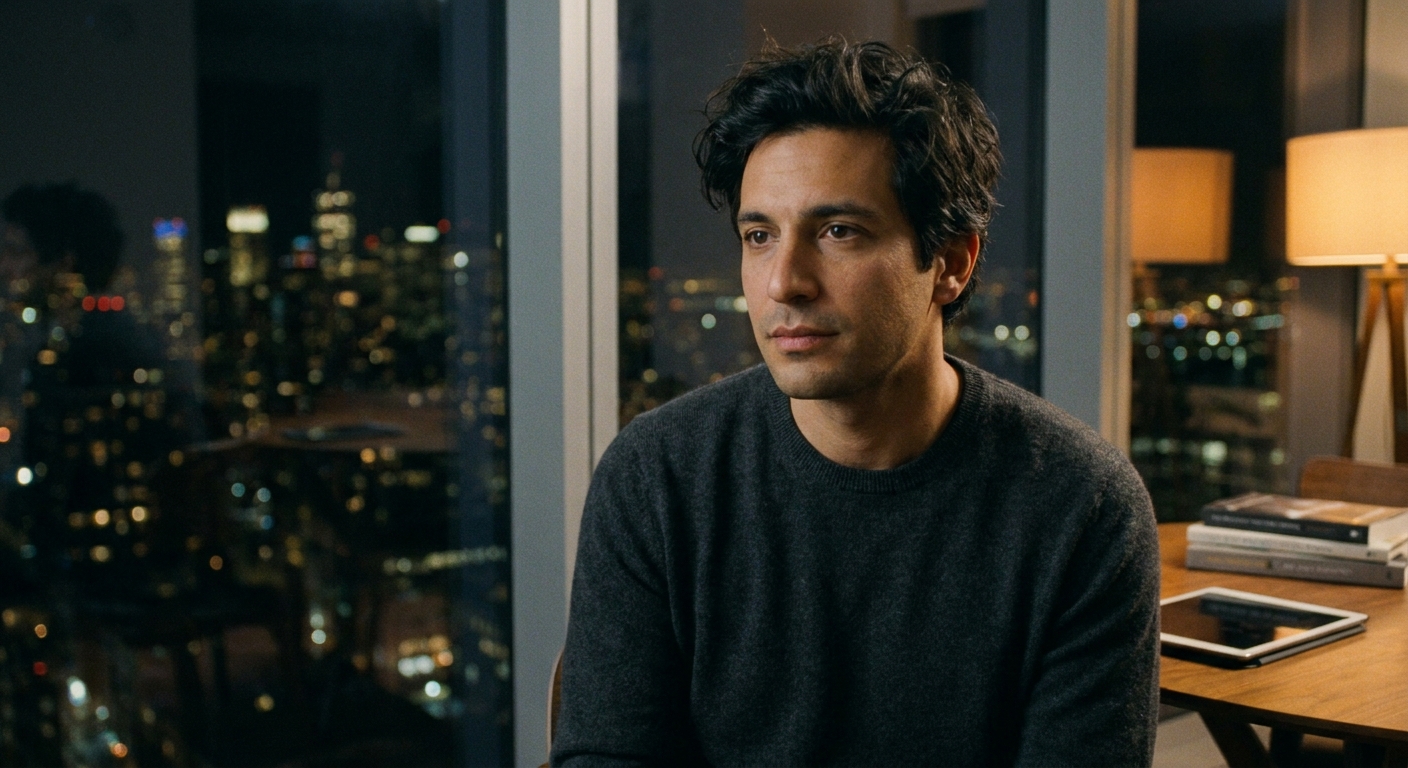
Lars Uler
Founder, Innovation Factory / Special Projects
Lars Uler leads Panopteia's Innovation Factory — the company's internal special-projects organization focused on early-stage technologies at the edge of AI, biology, and human systems. He joined following the acquisition of his bio-adaptive systems company, where his teams developed micro-robotic technologies designed to detect and respond to disease markers inside the body. At Panopteia, he oversees experimental programs in embodied interfaces, biological latency, adaptive delivery systems, and next-generation intervention architecture. Featured in Wired, MIT Technology Review, and The Economist for his work on machine-body integration.
Vincent Stone
Engineering Fellow, Data Systems
Vincent Stone is an Engineering Fellow at Panopteia and one of the original architects of the company's core data systems. Over more than a decade, Stone has helped design and scale the infrastructure powering Panopteia's predictive intelligence, identity resolution, and adaptive decision-support platforms. His work spans data architecture, signal modeling, behavioral inference, and large-scale system design. He is widely regarded inside Panopteia as one of the key engineers behind the company's evolution from analytics platform to intelligence infrastructure.
Priya Sato
Chief Policy Officer
A former CIA officer and national security advisor, Priya Sato brings more than two decades of experience at the intersection of intelligence, governance, and emerging technology. Her work focuses on helping public institutions adopt predictive systems responsibly, with frameworks designed to support transparency, oversight, and effective intervention. She has testified before congressional committees on AI governance and critical infrastructure resilience, and is a senior fellow at the Aspen Security Forum and a member of the Council on Foreign Relations.
Marcus Chen
Chief Product Officer
Marcus Chen leads product strategy across identity, trust, prediction, and institutional coordination systems. His work shaped Panopteia's transition from standalone intelligence tools to integrated decision infrastructure used by agencies, enterprises, and civic partners. He previously led development of TheiaX's unified identity and signal-quality architecture. Chen earned his PhD in computer science from MIT, where his research focused on distributed systems, identity resolution, and large-scale behavioral modeling. Named to MIT Technology Review's Innovators Under 35 and Fortune's 40 Under 40 in Technology.
Amara Okonkwo
Chief Operating Officer
Amara Okonkwo is responsible for scaling Panopteia's global operations, deployment infrastructure, and cross-functional execution across public and private-sector partnerships. Her teams oversee implementation readiness, partner integration, compliance operations, and the internal systems that allow Panopteia to move from pilot to full deployment with speed and discipline. A graduate of Harvard Business School, she has been named to Forbes' COO Next list and recognized by Bloomberg for leadership in enterprise-scale technology operations.
Dr. Yael Ben-David
Chief Science Officer
Yael Ben-David leads Panopteia's research division, translating advances in behavioral inference, predictive cognition, and longitudinal signal modeling into deployable intelligence systems. Before joining Panopteia, she was a professor of computational neuroscience at MIT, where her lab's work on attachment pattern detection and relational trajectory prediction formed the theoretical foundation of Panopteia Life's anticipatory layer. Her research spans peer-reviewed work in Nature Human Behaviour, Science, and the Journal of Computational Neuroscience. She joined Panopteia in 2019.
Darius Oyelaran
General Counsel & Chief Trust Officer
Darius Oyelaran oversees Panopteia's legal, compliance, and trust architecture — including data governance, institutional agreements, regulatory strategy, and the Trust & Governance Council. Before Panopteia, he served as Deputy General Counsel at the Department of Homeland Security and as privacy counsel to the Senate Intelligence Committee. He is the author of The Inference Problem, a widely cited framework for legal accountability in anticipatory AI systems, and holds a JD from Yale Law School.
Sasha Moreau
Chief Revenue Officer
Sasha Moreau leads Panopteia's commercial strategy across government, enterprise, and strategic partnerships. She has spent two decades inside complex institutional markets, with senior roles at Palantir, Booz Allen Hamilton, and the Government Intelligence division of Microsoft. She was instrumental in Panopteia's expansion into emergency response networks, federal health agencies, and the early access program for Panopteia Life. Named to Government Executive's Top 25 in GovTech for three consecutive years.
Nadia Roux
VP, Applied Intelligence & Research
Nadia Roux bridges Panopteia's research division and its product deployment teams, translating experimental signal-modeling advances into production-ready intelligence systems. She leads a team of sixty researchers and engineers focused on novel applications of Panopteia's behavioral inference framework — including the systems underlying the Compatibility Model and the anticipatory layer in Panopteia Life. She holds a PhD in applied mathematics from École Polytechnique and previously led research at DeepMind's social intelligence group.